
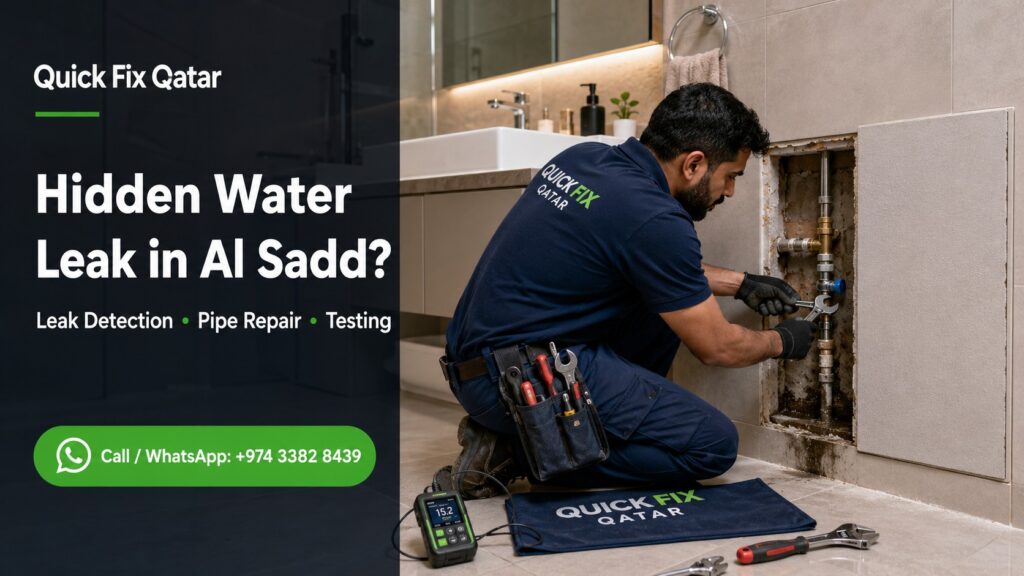
A hidden water leak can cause significant damage before it becomes clearly visible. Water may escape from concealed pipes behind walls, under floors, above ceilings, inside bathrooms or near plumbing fixtures without producing an obvious puddle.
If you notice damp patches, peeling paint, unusual water sounds, reduced pressure, rising water usage or recurring moisture in your property, the cause should be investigated before the damage becomes more serious.
Quick Fix Qatar provides hidden water leak detection and pipe repair in Al Sadd for apartments, villas, offices, shops and other properties.
We also serve nearby areas including Fereej Al Nasr, Al Mirqab and New Al Mirqab.
Call / WhatsApp: +974 3382 8439
Common Signs of a Hidden Water Leak
Hidden leaks are not always easy to identify. In many cases, the first warning signs appear on walls, ceilings, floors or plumbing fixtures.
Possible signs include:
Damp or wet wall patches
Peeling or bubbling paint
Water stains on ceilings
Swollen skirting or wooden finishes
Unusual mould-like marks
Persistent damp smell
Reduced water pressure
Sound of running water when taps are closed
Repeated water accumulation
Wet areas around bathrooms or kitchens
Loose tiles or damaged grout
Water appearing in a neighbouring room
Unexplained increase in water consumption
These symptoms can have different causes, so the exact source should be confirmed before opening walls or floors unnecessarily.
1. Leaks Inside Concealed Water Pipes
One common cause of hidden water damage is leakage from a concealed supply pipe.
These pipes may run:
Inside walls
Under floor tiles
Above false ceilings
Behind kitchen cabinets
Inside bathroom service areas
A damaged fitting, loose joint, cracked pipe or deteriorated connection may allow water to escape slowly.
The leak can then spread through plaster, gypsum, concrete or flooring before becoming visible.
2. Bathroom Water Leakage
Bathrooms are a common location for concealed water problems.
Possible sources include:
Basin supply pipes
Toilet connections
Shower mixers
Flexible hoses
Angle valves
Water-heater pipes
Concealed shower plumbing
Floor drains
Waste connections
Damaged sealant or waterproofing
A wet wall outside the bathroom does not always mean the visible wall itself is the source. Water can travel through structural or finishing materials before appearing elsewhere.
A proper inspection helps identify whether the issue is related to a pressurised pipe, drainage system, fixture or waterproofing.
3. Kitchen and Sink Leaks
Leaks under kitchen sinks can sometimes remain hidden behind cabinets.
Common causes include:
Loose flexible hoses
Damaged angle valves
Sink waste connections
Drain pipes
Mixer connections
Water filter connections
Dishwasher hoses
Small leaks can gradually damage cabinets, flooring and nearby walls.
If moisture is found under the sink, the area should be checked before simply drying it and continuing normal use.
4. Water Heater and Hot-Water Pipe Problems
Water heaters and their connected pipes can also cause concealed leakage.
Possible problem areas include:
Heater inlet connections
Hot-water outlet
Flexible hoses
Angle valves
Pressure-related fittings
Concealed hot-water pipes
Signs may include:
Water below the heater
Damp ceiling underneath
Moisture near bathroom walls
Reduced hot-water pressure
Repeated dripping
The heater, valves and connected pipework should be inspected to identify the actual source.
5. Drainage and Waste-Pipe Leakage
Not all leaks come from pressurised water pipes.
Wastewater or drainage pipes may also leak from:
Sink drains
Basin waste pipes
Toilet connections
Floor traps
Shower drains
Kitchen waste pipes
Drainage leaks may appear only when the fixture is being used.
For example, a ceiling stain may become wet only when someone uses the bathroom above.
This type of timing information can help during diagnosis.
6. Blockages and Pressure Problems
Sometimes the complaint appears to be a leak, but the underlying issue may involve a blockage or abnormal water pressure.
Examples include:
Partially blocked drain
Backflow from a floor trap
Overflowing fixture
Excessive pressure at a connection
Weak water flow due to a restriction
Loose connection affected by pressure
Quick Fix Qatar can inspect the plumbing system to determine whether the problem is related to leakage, drainage or water flow.
Our Hidden Water Leak Inspection Process
The exact method depends on the property and symptoms.
A typical inspection may include:
Step 1: Identify the Symptoms
We first check where the moisture appears and when it becomes worse.
Useful information includes:
When the problem started
Whether the area is always wet
Whether it becomes wet after using a specific fixture
Whether the water is clean or dirty
Whether pressure has reduced
Whether plumbing work was recently completed
This can help narrow down the possible source.
Step 2: Inspect Nearby Plumbing Fixtures
Nearby fixtures and accessible connections are checked first where practical.
This can include:
Taps
Mixers
Angle valves
Flexible hoses
Toilets
Water heaters
Sink waste pipes
Floor traps
Sometimes the source is accessible and can be repaired without opening finished surfaces.
Step 3: Check Flow and Pressure
Where relevant, the technician can assess water flow and pressure behaviour.
Unexpected pressure changes or flow problems may help indicate whether the issue is related to a supply pipe, fixture or blockage.
Step 4: Locate the Most Likely Leak Area
If the source is concealed, the next step is to narrow down the affected location as accurately as possible before opening walls, ceilings or floors.
The objective is to avoid unnecessary damage to tiles, paint, gypsum or other finishes.
Protecting Tiles, Paint and Other Finishes
Hidden pipe repair sometimes requires access through finished surfaces.
Possible areas include:
Tiled bathroom walls
Floor tiles
Gypsum ceilings
Painted walls
Kitchen cabinets
Before opening the area, the technician should identify the most practical access point.
Quick Fix Qatar can also coordinate related repair work such as:
Tile removal and replacement
Gypsum repair
Wall putty
Painting
Minor finishing work
This helps restore the area after the plumbing repair is completed.
Pipe Repair or Replacement
Once the damaged section is identified, the solution depends on the condition of the pipe or fitting.
Work may include:
Tightening or renewing connections
Replacing a damaged fitting
Replacing a leaking hose
Replacing an angle valve
Repairing a pipe section
Replacing a damaged pipe section
Correcting a waste connection
Replacing a broken drain component
Suitable materials should be selected according to the existing plumbing system and location.
Testing After the Repair
Repair work should not end immediately after the damaged component is replaced.
The affected plumbing should be checked again.
Testing may include:
Running water through the repaired line
Checking water pressure
Inspecting connections
Testing drainage
Monitoring the repaired area for leakage
Confirming normal flow
The area should only be closed and restored after the repair has been checked.
Hidden Water Leaks Behind Tiles
Water leaking behind bathroom or kitchen tiles can be difficult to locate visually.
Possible clues include:
Loose tiles
Damp grout
Water appearing at floor level
Moisture on the opposite side of the wall
Peeling paint outside the bathroom
Repeated wet patches
If access through tiles is necessary, the smallest practical area should be opened.
After the plumbing repair, damaged tiles can be replaced where matching material is available.
Water Leakage Above Gypsum Ceilings
A water stain on a gypsum ceiling may come from plumbing, AC drainage or another source above.
Before repairing the gypsum, the source of the water should be resolved.
Otherwise, the repaired ceiling may become damaged again.
Quick Fix Qatar can assist with related:
Plumbing inspection
AC drainage repair
Gypsum-board replacement
Joint finishing
Painting
Plumbing Services in Al Sadd
Quick Fix Qatar provides plumbing maintenance and repair services across Al Sadd.
Our services can include:
Hidden water leak inspection
Pipe repair
Pipe replacement
Tap and mixer repair
Toilet repair
Flush-system repair
Basin and sink plumbing
Water heater installation and repair
Angle-valve replacement
Flexible-hose replacement
Blocked drain cleaning
Floor-trap problems
Kitchen plumbing
Bathroom plumbing
The exact scope depends on the condition found during inspection.
Plumbing Services Near Fereej Al Nasr, Al Mirqab and New Al Mirqab
In addition to Al Sadd, our team serves nearby areas including:
Fereej Al Nasr
Al Mirqab
New Al Mirqab
Al Sadd
Bin Mahmoud
Al Waab
Al Rayyan
Other nearby Doha areas
Send your location and photos through WhatsApp to help us understand the problem.
What Affects the Cost of Hidden Leak Repair?
The price can vary considerably depending on the location and complexity of the leak.
Factors include:
Accessibility of the pipe
Type of pipe
Location of the leak
Amount of diagnosis required
Wall or floor opening
Tile removal
Ceiling access
Replacement materials
Length of damaged pipe
Fixture replacement
Finishing and restoration work
A visible leaking hose may be repaired quickly, while a concealed pipe below tiles may require more diagnosis and restoration work.
For this reason, final pricing may require inspection.
Why Choose Quick Fix Qatar?
Hidden water leaks often involve more than plumbing alone.
For example:
Pipe leak → damaged gypsum ceiling → plumbing repair → gypsum replacement → repainting
or:
Concealed bathroom leak → tile opening → pipe replacement → tile restoration
Quick Fix Qatar provides multiple home-maintenance services under one team, including:
Plumbing Services
Tiles Works
Painting Services
Gypsum Works
Electrical Services
AC Repair & Servicing
Home Maintenance
This makes it easier to coordinate both the repair and the finishing work.
Frequently Asked Questions
How can I know if I have a hidden water leak?
Common signs include damp walls, ceiling stains, peeling paint, unusual moisture, reduced pressure or the sound of running water when fixtures are closed.
Can you detect a leak behind bathroom tiles?
We can inspect the plumbing and symptoms to narrow down the likely source. If access is required, the affected tile area may need to be opened.
Do you repair the damaged pipe after locating the leak?
Yes. Once the problem is identified and the repair scope is agreed, damaged pipes, fittings or connections can be repaired or replaced.
Can you repair tiles after plumbing work?
Yes. Quick Fix Qatar also provides tile work. Replacement depends on the availability of matching tiles.
Can a blocked drain look like a leak?
Yes. Overflow or drainage problems can sometimes create water accumulation that appears similar to a leak.
Do you test the repair afterwards?
Yes. Flow, pressure, drainage and visible leakage should be checked after the repair.
Can I send photos through WhatsApp?
Yes. Send clear photos or a short video of the affected area, along with your location and a description of when the problem occurs.
Need a Plumber in Al Sadd for a Hidden Water Leak?
If you notice damp walls, water stains, reduced pressure or unexplained moisture, it is better to identify the source before the damage spreads.
Quick Fix Qatar provides hidden water leak detection, plumbing fault inspection and pipe repair in Al Sadd, Fereej Al Nasr, Al Mirqab, New Al Mirqab and nearby Doha areas.
We can inspect the affected area, identify the likely cause, repair or replace the damaged pipe or fixture, test the plumbing and coordinate related finishing work where required.
Call / WhatsApp: +974 3382 8439
Send your location, photos or video and a short description of the problem for an initial assessment.