
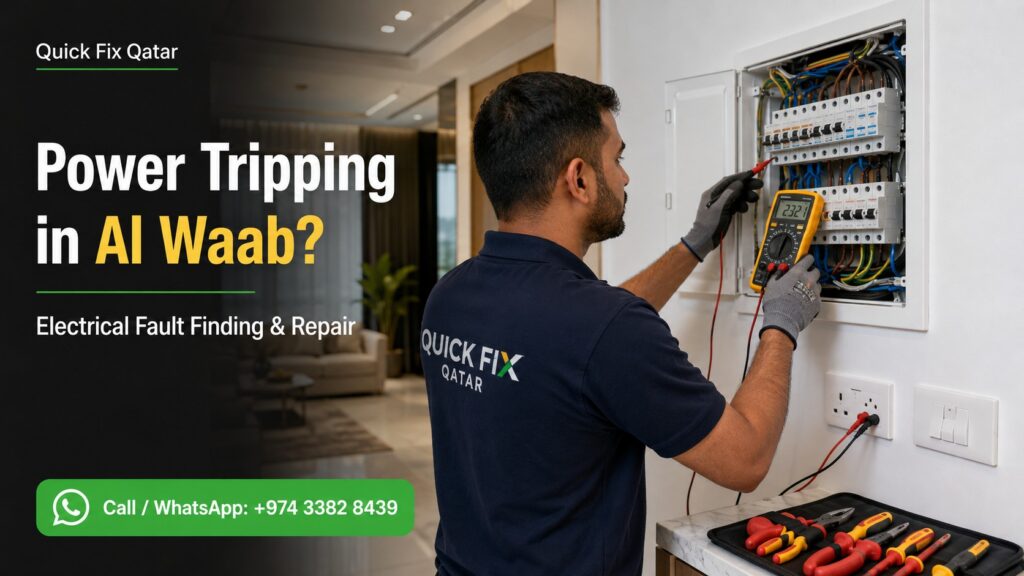
A circuit breaker that keeps tripping is more than an inconvenience. It can be a warning that something in the electrical system needs inspection.
The problem may be related to an overloaded circuit, faulty appliance, damaged cable, loose connection, defective switch or socket, breaker problem, or another electrical fault. Instead of repeatedly resetting the breaker, the safer approach is to identify why it is operating.
If you need an electrician in Al Waab for power tripping or electrical fault finding, Quick Fix Qatar provides inspection, diagnosis and electrical repair services for homes, villas, apartments, shops and offices.
We also serve nearby areas including Baaya, Villaggio Area and Aspire Zone.
Call / WhatsApp: +974 3382 8439
Why Does the Circuit Breaker Keep Tripping?
A circuit breaker is designed to disconnect the electrical supply when abnormal electrical conditions occur.
If a breaker trips once because several high-load appliances were operating simultaneously, the reason may be relatively straightforward. However, when the same breaker trips repeatedly, immediately after resetting, or whenever a particular appliance or light is switched on, further investigation is recommended.
Common causes can include:
Electrical circuit overload
Short circuit
Earth leakage or insulation fault
Damaged or loose wiring
Faulty socket or switch
Damaged light fitting
Defective electrical appliance
Weak or damaged circuit breaker
Water or moisture affecting electrical components
Incorrect or deteriorated connections
The actual cause should be confirmed through inspection and appropriate electrical testing.
1. Electrical Overload
An overloaded circuit is one possible reason for repeated breaker tripping.
This can happen when several electrical appliances are connected to the same circuit and their combined load exceeds what that circuit is designed to handle.
For example, a circuit may experience problems when multiple high-power appliances operate together.
Rather than simply replacing the existing breaker with a higher-rated one, the circuit and connected load should first be assessed.
Installing a larger breaker without confirming the cable capacity and circuit design can create additional electrical risk.
A technician may therefore check:
What equipment is connected to the affected circuit
Breaker rating
Cable condition and capacity
Distribution board arrangement
Whether another circuit is carrying excessive load
Whether new electrical equipment has recently been added
The correct solution depends on the existing installation and measured conditions.
2. Short Circuit
A short circuit can cause a breaker to trip quickly or immediately.
Possible causes may include damaged wiring, loose conductors, damaged accessories, incorrect connections or deterioration inside electrical equipment.
Some warning signs can include:
Breaker trips immediately after resetting
Burning smell
Spark from a socket or switch
Black or discoloured electrical accessories
Circuit fails when a particular switch is operated
Tripping started after electrical installation or repair work
If these symptoms occur, avoid repeatedly resetting the breaker.
The affected circuit should be safely isolated and inspected.
3. Faulty Electrical Appliance
Sometimes the building wiring is not the primary problem.
A faulty appliance connected to the circuit may cause the protection device to operate.
Possible examples include:
Water heater
Washing machine
Refrigerator
Microwave
Electric cooker
Dishwasher
Air-conditioning equipment
Water pump
Other high-load electrical equipment
If the tripping happens whenever one specific appliance starts operating, that equipment should be included in the fault investigation.
However, the technician should not automatically assume that the appliance itself is defective. The socket, circuit wiring, isolator and protective device may also need checking.
4. Damaged Socket or Switch
Loose, burnt or damaged electrical accessories can also create faults.
Common symptoms include:
Crackling noise from a socket
Socket becoming unusually warm
Loose switch
Visible burn marks
Intermittent power
Sparking when plugging in equipment
Breaker trips when using a particular socket
Light trips when operating a particular switch
A damaged accessory may require replacement, but the wiring behind it should also be inspected before installing the new component.
Simply changing the visible socket or switch may not solve the problem if damaged or loose connections remain behind it.
5. Lighting Circuit Problems
If power trips when lights are switched on, the problem may be within the lighting circuit.
Potential areas to inspect include:
Ceiling light fittings
LED drivers
Transformers
Dimmer switches
Damaged wiring
Loose connectors
Junction points
Outdoor lighting
Moisture-affected fittings
Modern lighting systems can contain several electronic components, so identifying the actual faulty component is important before replacement.
For example, replacing an LED fitting may not solve the problem if the fault is actually in the driver, cable or connection point.
6. Water or Moisture Near Electrical Wiring
Water and electricity require immediate attention.
Electrical tripping may sometimes begin following:
Plumbing leakage
AC water leakage
Ceiling water damage
Bathroom leakage
Outdoor rain exposure
Water heater problems
Moisture entering a light fitting or socket
If electrical tripping starts after water leakage, the affected area should be treated cautiously.
Do not continue resetting the breaker until the electrical installation has been inspected.
Quick Fix Qatar can also assess related plumbing, AC, ceiling or maintenance problems when they are connected with the electrical issue.
7. Distribution Board or Breaker Problems
The distribution board is an important part of the property’s electrical system.
During fault diagnosis, the electrician may need to inspect:
Circuit breakers
Main connections
Cable termination
Signs of overheating
Loose connections
Damaged components
Circuit identification
Available electrical load
General DB condition
Sometimes a breaker itself may have deteriorated and require replacement.
However, replacing a breaker should normally be done after identifying why it is tripping.
If the underlying problem is a cable fault, overload or faulty electrical equipment, changing the breaker alone may not solve the problem.
Our Electrical Fault-Finding Process
When attending a power-tripping problem, the exact procedure depends on the symptoms and condition of the property.
A typical inspection may include the following stages.
Step 1: Understand When the Tripping Happens
The technician first needs to understand the behaviour of the fault.
Useful information includes:
Which breaker is tripping?
Does it trip immediately or after some time?
Does it happen when a particular appliance is used?
Does it happen when lights are switched on?
Did the problem begin after recent electrical work?
Was there any water leakage?
Were any new appliances recently installed?
Is the problem affecting one room or the whole property?
This information can make fault diagnosis faster.
Step 2: Safe Isolation
Before inspecting electrical connections, the affected circuit should be isolated safely.
Electrical panels, cables and live components should be handled by someone competent to carry out the work.
Do not remove DB covers, open live electrical connections or attempt internal wiring repairs without appropriate knowledge and equipment.
Step 3: Breaker and Circuit Inspection
The technician can inspect the affected breaker and corresponding circuit for visible signs of problems.
The inspection may identify:
Loose connections
Burnt terminals
Heat damage
Damaged wiring
Incorrect connections
Deteriorated accessories
Further testing may then be required.
Step 4: Cable, Switch, Socket and Load Testing
Depending on the problem, testing may involve relevant parts of the circuit, including:
Electrical cables
Breakers
Switches
Sockets
Light fittings
Connected equipment
Isolators
Distribution board connections
The objective is to locate the actual fault rather than replacing components unnecessarily.
Step 5: Repair or Replacement
Once the faulty component or connection has been identified, the required repair can be discussed with the customer.
Depending on the problem, work may involve:
Replacing a damaged breaker
Repairing or replacing wiring
Replacing a burnt socket
Replacing a damaged switch
Correcting loose connections
Replacing faulty electrical accessories
Repairing lighting connections
Separating or modifying circuits where technically appropriate
Any additional materials or work discovered during inspection should be explained before proceeding.
Step 6: Final Testing
After completing the repair, the circuit should be checked again.
The technician can confirm that:
The repaired circuit is operating
The breaker remains stable under normal conditions
Switches and sockets operate correctly
Repaired connections are secure
Connected equipment functions normally where applicable
The affected area is safe to return to normal use based on the completed scope
Testing after repair is an important part of the job.
Should You Keep Resetting a Tripped Breaker?
Generally, repeatedly resetting a breaker without knowing why it is tripping is not recommended.
If it trips again immediately, leave the affected circuit switched off and arrange an inspection.
You should seek electrical assistance promptly if you notice:
Burning smell
Smoke
Sparks
Melted socket or switch
Very hot electrical accessory
Repeated immediate tripping
Electrical shock or tingling sensation
Water around electrical equipment
Unusual buzzing or crackling from the DB
These symptoms should not be ignored.
What Information Should You Send Us?
When contacting Quick Fix Qatar about electrical tripping, sending some basic information can help us understand the problem before attending.
You can WhatsApp us:
Photo of the distribution board
Photo of the breaker that is tripping
Short video showing the problem, if safe
Location
Type of property
When the tripping started
Whether any particular appliance causes it
Whether recent electrical work was carried out
Whether any leakage or water damage occurred
Never open live electrical equipment just to take a photo.
Only photograph areas that are safely accessible.
Electrical Repair Services in Al Waab
Quick Fix Qatar provides electrical troubleshooting and maintenance for residential and commercial properties in Al Waab.
Our electrical services can include:
Power-tripping diagnosis
Electrical fault finding
Circuit breaker replacement
Distribution board inspection
Socket repair and replacement
Switch replacement
Lighting fault repair
Wiring repair
Short-circuit investigation
Electrical load checking
Isolator replacement
Light installation
Electrical maintenance
Emergency electrical troubleshooting
The exact repair scope depends on the condition found during inspection.
Electrician Near Baaya, Villaggio Area and Aspire Zone
Our service coverage also includes areas close to Al Waab, such as:
Baaya
Villaggio Area
Aspire Zone
Al Rayyan
Ain Khaled
Abu Hamour
Al Waab
Nearby Doha residential areas
If you are unsure whether your property is within our service area, send us your location through WhatsApp.
How Much Does Electrical Fault Finding Cost?
The cost depends heavily on the nature of the problem.
A simple faulty switch or loose connection may require much less work than an intermittent cable fault that takes significant time to trace.
The final price may depend on:
Type of electrical fault
Time required for diagnosis
Number of circuits affected
Accessibility of wiring
Distribution board condition
Required replacement parts
Cable replacement requirements
Ceiling or wall access
Working height
Additional testing
Whether gypsum or finishing work is required after accessing concealed wiring
For straightforward problems, photos and information may help us provide an initial indication.
For complicated or intermittent faults, inspection is normally required before confirming the complete repair cost.
Concealed Wiring and Gypsum Ceiling Faults
Some electrical wiring runs above gypsum ceilings or inside walls.
If a fault is found in a concealed section, access may sometimes be required to reach the affected cable or connection.
Where necessary, Quick Fix Qatar can coordinate related work such as:
Gypsum ceiling opening
Electrical cable repair
Reclosing the access area
Putty and surface preparation
Repainting the repaired section
This can be useful where both electrical and finishing work are required.
Why Choose Quick Fix Qatar for Electrical Repairs?
Power-tripping problems sometimes involve more than one maintenance trade.
For example:
AC leakage → electrical fitting affected → breaker tripping
or
Concealed wiring fault → gypsum ceiling opened → cable repaired → ceiling repaired and repainted
Quick Fix Qatar provides multiple maintenance services under one team, including:
Electrical Services
Plumbing Services
AC Repair & Servicing
Painting Services
Gypsum Works
Carpentry
General Home Maintenance
This makes it easier to coordinate related repairs where more than one type of work is required.
Frequently Asked Questions
Why does my breaker keep tripping?
Possible causes include overload, short circuit, earth leakage, faulty appliances, damaged wiring, defective electrical accessories or other circuit problems.
The actual reason needs to be diagnosed rather than assumed.
Can a faulty socket cause power tripping?
Yes, a damaged socket, loose wiring or a fault connected to that circuit may cause the protective device to operate. The socket and circuit should be inspected.
Why does the breaker trip when I turn on a light?
The problem may involve the light fitting, LED driver, switch, wiring, connector or another component on the lighting circuit.
Can you just replace the breaker?
A breaker can be replaced when it is confirmed to be faulty or replacement is otherwise appropriate. However, repeatedly tripping breakers should first be investigated because the breaker may simply be responding to another fault.
Can you find a fault inside concealed wiring?
Electrical fault finding can help narrow down the affected circuit or component. If physical access to concealed wiring is required, further work may be necessary.
Do you repair gypsum after electrical work?
Where agreed within the scope, Quick Fix Qatar can also handle gypsum repair and painting after electrical access work.
Can I send a photo before booking?
Yes. Send photos of the distribution board and affected electrical accessories, together with a description of when the breaker trips.
Do not remove electrical covers or expose live wiring just to take photos.
Need an Electrician in Al Waab?
If your circuit breaker keeps tripping, lights suddenly lose power, sockets stop working or you suspect an electrical fault, avoid repeatedly resetting the system without identifying the cause.
Quick Fix Qatar provides power-tripping diagnosis and electrical fault finding in Al Waab, Baaya, Villaggio Area, Aspire Zone and nearby Doha locations.
We can inspect the affected circuit, identify the likely fault, carry out the agreed repair or replacement and test the system after completion.
Call / WhatsApp: +974 3382 8439
Send your location, DB photo and a brief description of the problem through WhatsApp for an initial assessment.