
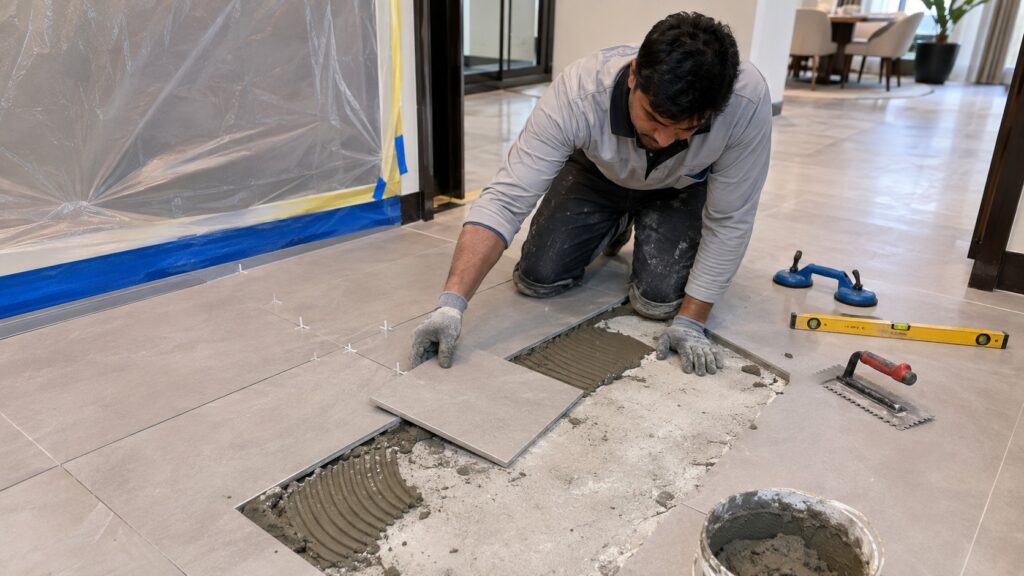
Loose, hollow or cracked floor tiles can make a home, apartment, shop or office look damaged and may also create a trip or breakage risk if the problem becomes worse.
Sometimes only one or two tiles need attention. In other cases, several tiles may sound hollow, move underfoot or crack repeatedly because of problems below the tiled surface.
Quick Fix Qatar provides professional tile work in Al Mansoura, including inspection, damaged-tile removal, surface preparation, tile replacement, adhesive work, levelling, spacing and grouting.
We also serve nearby areas including Najma and Umm Ghuwailina.
Call / WhatsApp: +974 3382 8439
Loose, Hollow or Cracked Tiles: What Is the Difference?
These problems may look similar, but they are not always caused by the same issue.
Loose Tiles
A tile may move slightly when stepped on or may no longer be properly bonded to the surface below.
Hollow Tiles
A tile can sound hollow when tapped because part of the tile may not be fully bonded to the substrate.
A hollow sound does not always mean the tile will immediately fail, but widespread hollow areas can indicate poor bonding or incomplete adhesive coverage.
Cracked Tiles
A tile may crack because of:
Impact
Movement below the tile
Uneven substrate
Poor adhesive support
Heavy loading
Existing structural or screed cracks
Incorrect installation
Expansion or movement stresses
Before replacing the tile, it is useful to understand why the damage happened.
1. Why Do Floor Tiles Become Loose?
Loose tiles are commonly related to bonding problems between the tile and the surface underneath.
Possible causes include:
Insufficient tile adhesive
Poor adhesive coverage
Dust or contamination below the tile
Incorrect surface preparation
Old or deteriorated adhesive
Movement in the screed
Water entering below the tile
Previous poor-quality installation
Uneven substrate
Repeated impact or heavy load
Simply replacing the tile without checking the underlying surface may allow the problem to return.
2. Why Do Tiles Sound Hollow?
A hollow sound usually indicates that the tile is not fully supported over its entire underside.
This can happen when:
Adhesive was applied unevenly
Parts of the tile have lost bond
Voids remain below the tile
The substrate was not properly prepared
The tile has begun separating from the adhesive
One hollow tile may not require the same response as a large area where many tiles are affected.
Quick Fix Qatar can inspect the condition and advise whether local repair or replacement is more suitable.
3. Why Do Tiles Crack?
A cracked tile may result from the tile itself or from movement underneath.
Possible causes include:
Heavy object dropped on the tile
Furniture impact
Uneven floor
Weak screed
Existing substrate crack
Poor adhesive support
Movement between floor sections
Improper installation
Damaged tile before installation
A single impact crack may be straightforward to replace.
Repeated cracking in the same area may need more investigation before installing another tile.
Repair or Replace: Which Is Better?
The correct approach depends on the actual condition.
A Tile May Be Suitable for Replacement When:
It is visibly cracked
It moves when stepped on
Corners or edges are broken
Bonding has failed
The surface is badly chipped
The tile cannot be repaired neatly
A matching replacement tile is available
Local Repair May Be Possible When:
The problem is limited to the grout
Only a minor joint defect is present
A tile is still firmly fixed but nearby finishing needs attention
The issue is around an edge or transition rather than the full tile
In many cases, a genuinely loose or cracked floor tile is better removed and reinstalled or replaced rather than cosmetically covered.
4. Inspection Before Removing the Tile
Before starting repair work, the affected area should be checked carefully.
The technician may inspect:
Number of damaged tiles
Hollow sound around the area
Tile movement
Grout condition
Floor level
Nearby cracks
Moisture or leakage
Type and size of tile
Availability of matching replacement tiles
This helps determine whether the problem is isolated or part of a larger flooring issue.
5. Careful Tile Removal
Damaged tiles should be removed carefully to reduce the chance of damaging neighbouring tiles.
The process may include:
Protecting the surrounding area
Removing grout around the affected tile where necessary
Breaking or lifting the damaged tile carefully
Removing old adhesive
Cleaning the exposed surface
Checking the substrate condition
Special care may be required where:
Replacement tiles are limited
Adjacent tiles are expensive
Tiles are large-format
The installation is close to walls, doors or sanitary fittings
6. Surface Levelling and Preparation
After tile removal, the surface below should be inspected.
If the substrate is uneven, loose or damaged, preparation may be required before the new tile is installed.
Possible work includes:
Removing loose adhesive
Cleaning dust and debris
Levelling small irregularities
Repairing minor damaged areas
Checking the screed
Allowing repaired areas to set where required
A flat and stable surface helps the replacement tile sit correctly.
7. Choosing the Correct Tile Adhesive
Suitable tile adhesive should be selected according to the tile type, location and substrate.
The adhesive should be:
Mixed correctly
Applied evenly
Suitable for the surface
Suitable for the tile type and size
Proper adhesive coverage helps reduce unsupported hollow areas.
For larger tiles, installation may require more careful adhesive application to achieve proper support.
8. Correct Tile Alignment and Spacing
A replacement tile should not only be securely fixed; it should also align with the surrounding floor.
The technician should check:
Height
Level
Joint width
Tile direction
Pattern alignment
Edge alignment
A poorly aligned replacement may remain obvious even if the tile itself matches perfectly.
9. Grouting the Repaired Area
After the tile is properly fixed and the adhesive has set as required, the joints can be grouted.
The grout should be:
Applied neatly
Consistent with surrounding joints
Cleaned from the tile surface
Allowed to cure appropriately
Where possible, grout colour should be selected to blend with the existing flooring.
However, older grout may have changed colour over time, so an exact visual match is not always possible.
10. Final Cleaning and Inspection
After completion, the repaired area should be checked for:
Tile alignment
Level
Joint width
Movement
Visible adhesive residue
Grout finish
General cleanliness
The work area should then be cleaned before handover.
What If Matching Tiles Are Not Available?
This is one of the most common problems in tile repair.
Older tiles may no longer be available in the same:
Colour
Pattern
Size
Finish
Batch
If the customer has spare tiles, these are usually the best option.
If no matching tile is available, possible alternatives include:
Searching local tile suppliers
Using the closest available match
Taking a tile sample for comparison
Replacing a larger section with a new design
Creating a deliberate feature or transition area
The most suitable option depends on the location and appearance of the floor.
Should You Keep Spare Tiles After Installation?
Yes.
If you are carrying out new tiling work, keeping a few spare tiles can be very useful for future repairs.
Tile designs, batches and shades may change or become unavailable.
A small quantity of spare tiles can make future repair much easier and help maintain a consistent appearance.
Tile Repair After Plumbing Leaks
Water leakage can sometimes affect floor or wall tiles.
Examples include:
Bathroom pipe leak
Kitchen leak
Concealed pipe repair
Drainage work
Toilet repair
Water-heater pipe repair
If tiles need to be opened to access concealed plumbing, Quick Fix Qatar can coordinate:
Tile opening → plumbing repair → substrate preparation → tile replacement → grouting
This can reduce the need to arrange multiple contractors for one repair.
Loose Bathroom Tiles
Bathrooms may experience loose tiles because of:
Moisture
Poor previous bonding
Water leakage
Failed grout
Movement
Repeated wet conditions
If water is getting behind the tiles, the underlying cause should be investigated before reinstalling them.
Simply fixing the tile without addressing the moisture problem may not provide a lasting result.
Cracked Kitchen Tiles
Kitchen floor tiles can be damaged by:
Heavy appliances
Dropped utensils or equipment
Furniture movement
Uneven flooring
Existing installation defects
If one tile is cracked because of impact, local replacement may be enough.
If several tiles are cracking in a line or the same area, the substrate should be checked more carefully.
Tile Work for Apartments and Villas in Al Mansoura
Quick Fix Qatar provides tile repair and installation services for:
Apartments
Villas
Kitchens
Bathrooms
Living rooms
Corridors
Balconies
Entrances
Shops
Offices
Small commercial spaces
Our services can include:
Loose tile repair
Hollow tile replacement
Cracked tile replacement
Floor tile installation
Wall tile installation
Tile removal
Tile adhesive work
Grouting
Regrouting
Minor floor levelling
Tile replacement after plumbing work
Small damaged-area restoration
Tile Work in Najma and Umm Ghuwailina
In addition to Al Mansoura, our team also serves nearby areas including:
Najma
Umm Ghuwailina
Al Mansoura
Old Airport
Al Muntazah
Al Hilal
Doha central areas
Nearby residential locations
Send your location and photos through WhatsApp to help us understand the work required.
What Affects the Cost of Tile Repair?
The cost depends on the actual scope.
Important factors include:
Number of damaged tiles
Tile size
Tile type
Availability of replacement tiles
Amount of old adhesive removal
Floor levelling requirement
Substrate damage
Location of the repair
Plumbing work underneath
Grout matching
Cutting requirement
Access conditions
Required finishing quality
Replacing one accessible tile is very different from repairing a large section of hollow or uneven flooring.
A final quotation should therefore be based on the actual condition.
Can Hollow Tiles Be Left Without Repair?
It depends on the condition.
A tile that sounds slightly hollow but is:
Stable
Not cracked
Not moving
Not causing any immediate problem
may not require urgent replacement.
However, if the tile:
Moves
Cracks
Produces noticeable movement under load
Has broken grout around it
Is part of a wider affected area
inspection and repair may be more appropriate.
Common Tile Repair Mistakes
Installing a New Tile Over Loose Material
New adhesive should not be applied over weak, dusty or unstable material without proper preparation.
Using Too Little Adhesive
Insufficient coverage can create unsupported areas below the tile.
Ignoring Floor Level
The replacement tile should align with surrounding tiles.
Grouting Before the Tile Is Ready
The adhesive should be allowed to set appropriately before final grouting.
Ignoring the Cause of Repeated Cracking
If several replacement tiles keep cracking, the underlying floor or movement problem may need attention.
Why Choose Quick Fix Qatar?
Tile problems can sometimes involve plumbing, wall repair or other maintenance.
For example:
Hidden pipe leak → tile removal → plumbing repair → tile replacement
or:
Damaged floor → levelling → tile installation → grout and final cleaning
Quick Fix Qatar provides multiple services under one team, including:
Tiles Works
Plumbing Services
Painting Services
Gypsum Works
Electrical Services
Home Maintenance
Handyman Services
This can make repair work easier to coordinate.
Frequently Asked Questions
Can you repair one cracked floor tile?
Yes. If a suitable replacement tile is available and the surrounding area is in good condition, a single tile can often be replaced.
Can you repair hollow tiles?
Hollow areas should first be inspected. Where the bond has failed or the tile is moving, removal and reinstallation or replacement may be recommended.
Can you remove a tile without damaging the nearby tiles?
Careful removal can reduce the risk, but tile-removal work always requires caution, especially when tiles are tightly spaced or brittle.
Do I need to provide replacement tiles?
If you already have matching spare tiles, they are ideal for repair work. If not, we can discuss available options.
Can you repair the floor below the tile?
Minor surface preparation or levelling can be included where required. Larger screed or structural problems may require additional work.
Can you replace tiles after fixing a plumbing leak?
Yes. Quick Fix Qatar also provides plumbing services and can coordinate tile restoration after the repair.
Can you regrout old tiles?
Yes. Regrouting or grout repair can be assessed separately depending on the condition of the joints.
Can I send photos for a quotation?
Yes. Send clear photos, approximate tile size, number of damaged tiles and your location through WhatsApp.
For larger or unclear problems, a site visit may be required.
Need Tile Repair in Al Mansoura?
If your floor tiles are loose, hollow, cracked or uneven, Quick Fix Qatar can inspect the affected area and advise whether local repair or replacement is the more practical option.
Our process can include:
Inspection → careful removal → surface preparation → adhesive and levelling → tile installation → spacing and grout → final cleaning
We provide tile repair and installation services in Al Mansoura, Najma, Umm Ghuwailina and nearby Doha areas.
Call / WhatsApp: +974 3382 8439
Send us:
Your location
Photos or video
Number of damaged tiles
Approximate tile size
Whether you have matching spare tiles
Details of any nearby plumbing or water-leak problem